
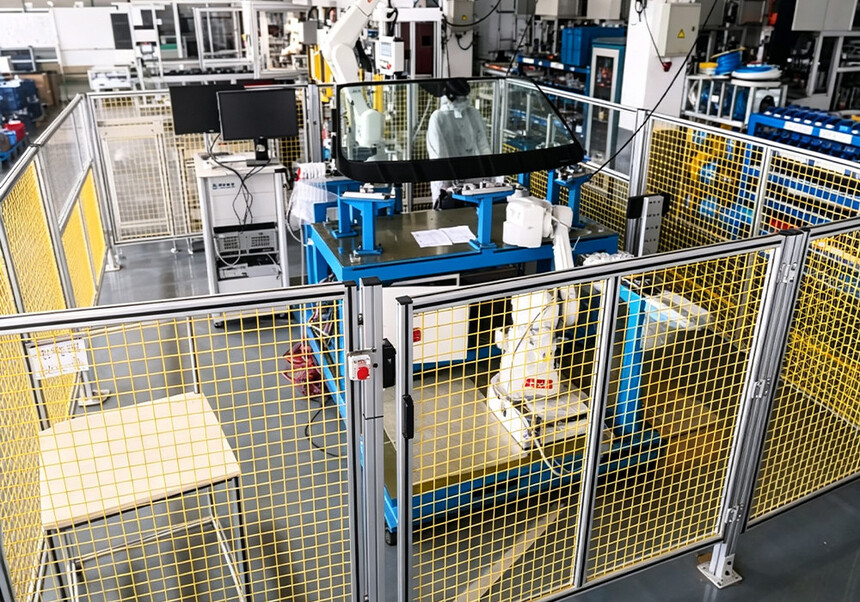
Sunroof Electronic Test Fixture, HUD Testing Station
-
Applicable Products: Automotive sunroof electronic components, HUD (Head-Up Display) modules.
-
Core Functions:
-
Sunroof Electronic Test Fixture: Functional testing, endurance (life cycle) testing, and current detection to verify the reliability of the sunroof electronic control system.
-
HUD Testing Station: Utilizes machine vision inspection technology to test parameters such as display effects, clarity, distortion, and brightness, accurately identifying defects.
-
-
Solution Highlights: Vision inspection replaces subjective manual judgment, ensuring unified testing standards and traceable results; test parameters are customizable to match the product standards of different vehicle models; supports both offline sampling and in-line 100% inspection modes.
Description
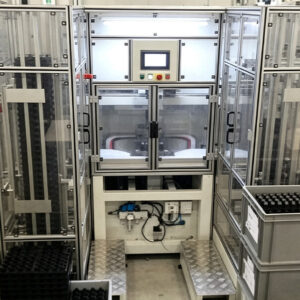
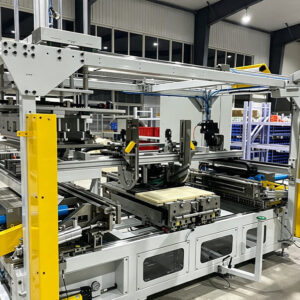
This testing fixture interfaces with sunroof drive motors, limit sensors, and anti-pinch sensor modules. It automates the simulation of full operating condition tests, including fully open, fully closed, and anti-pinch trigger states. High-definition (HD) vision is utilized to inspect sunroof sealing gaps and assembly flatness. As a standalone benchtop unit, it is ideally suited for the 100% factory inspection of sunroof components and can be seamlessly integrated with interior assembly lines.
Key Advantages & Highlights
|
Full Sunroof Operating Condition Simulation |
Simulates all scenarios including fully open, half open, anti-pinch protection, and limit power-off. |
|
High-Precision Vision Gap Inspection |
Sunroof sealing gap inspection accuracy of ±0.01mm. |
|
Closed-Loop Precision Control of Anti-Pinch Force |
Detects the anti-pinch trigger force with an accuracy of ±0.2N, complying with national safety standards for sunroofs. |
|
Vehicle Model Program Database Storage |
Built-in sunroof electronic control test programs for multiple vehicle models, featuring one-click switching. |
|
Lightweight Benchtop Structure |
The entire unit has a footprint of only 6m², allowing it to be placed at any inspection workstation in the workshop. |
|
Automatic Generation of Quality Inspection Reports |
One-click export of IATF-compliant PDF reports. |
Core System Specifications Table
|
Applicable Products |
Panoramic and split sunroof electronic control assemblies for ICE (Internal Combustion Engine) and NEV (New Energy Vehicle) models |
|
Test Cycle Time per Unit |
80s / set |
|
Control System |
Siemens S7-1500 compact PLC, 10-inch touch HMI |
|
Anti-Pinch Force Detection Accuracy |
±0.2N, range 5~100N |
|
Gap Vision Inspection Accuracy |
±0.01mm |
|
Simulated Operating Conditions |
5 operating modes: fully open, half open, closed, anti-pinch trigger, and limit power-off |
|
Traceability Method |
Sunroof assembly 2D barcode binding electronic control, gap, and anti-pinch force inspection data |
|
Equipment Footprint |
6m² benchtop standalone fixture |
Core Functions and Value in Detail
|
Full Operating Condition Simulation Test for Sunroof Electronic Control |
The fixture interfaces with the sunroof motor, limit switch, and anti-pinch sensor to automatically execute cycles of fully open, half open, and closed. It simulates foreign object triggering of the anti-pinch protection, testing the anti-pinch response speed and power-off limit accuracy. This verifies the safety logic of the sunroof electronic control module, eliminating hidden safety hazards such as pinching during driving or failure to close. |
|
Precision Closed-Loop Detection of Sunroof Anti-Pinch Force |
The servo outputs standard pressure to simulate foreign object obstruction, collecting the anti-pinch trigger force in real-time. It automatically compares the data with the national standard safety range. Faulty parts with excessive force (causing passenger injury) or insufficient force (causing false triggering) are automatically diverted, ensuring compliance with sunroof driving safety standards. |
|
Vision Inspection of Sunroof Sealing Gap |
HD vision cameras scan the assembly gap between the sunroof glass and body frame, automatically determining if the gap meets the OEM’s drawing tolerances. Workpieces with out-of-tolerance gaps are marked as defective to prevent vehicle water leakage and excessive wind noise faults. |
|
Automatic Generation and Export of Inspection Reports |
Upon completion of testing for each sunroof set, the system automatically generates a PDF quality inspection report, including all numerical values for electronic control response time, anti-pinch force, and sealing gap. This report can be directly used for OEM second-party audits, eliminating the need for manual recording of inspection data. |
|
Single-Piece Quality Traceability for Sunroof Components |
Each sunroof assembly is bound to a unique 2D barcode, with electronic control, anti-pinch, and gap inspection data permanently stored. Integration with the MES achieves full-process quality traceability for interior sunroof components. |
Supporting Services & Delivery Assurance
-
Pre-project: Operating condition simulation for sunroof electronic control samples, anti-pinch force testing process calibration, and workshop workstation layout planning;
-
Lead Time: 30 working days for a standard benchtop fixture;
-
Implementation: In-house full-load pre-testing of sunroof samples → On-site joint commissioning of electronic control simulation and vision gap units → 48-hour continuous trial run acceptance;
-
Training: Vehicle model program changeover, anti-pinch force parameter calibration, quality inspection report exporting, and vision gap program debugging;
-
After-sales: 1-year warranty for the entire machine, and a 2-year warranty for vision cameras and anti-pinch force sensors; 4-hour response time, nationwide 24-hour on-site maintenance; lifetime cost-effective supply of sunroof positioning fixtures.
HUD Testing Station
This is a dedicated precision vision inspection workstation for automotive Head-Up Displays (HUDs). Equipped with a high-resolution imaging vision system, it simulates in-vehicle multi-lighting environments (daylight and nighttime) to automatically inspect projection clarity, color chromatic aberration, optical path assembly accuracy, and display defects. Featuring a standalone enclosed benchtop testing fixture, it is ideally suited for the 100% factory inspection of automotive HUD components and is compatible with both AR-HUD (Augmented Reality HUD) and standard W-HUD (Windshield HUD) products.
Key Advantages & Highlights
|
Multi-Lighting Environment Simulation System |
Simulates vehicle usage scenarios such as strong daylight and weak nighttime light. |
|
High-Precision Imaging Vision Inspection |
Identifies micron-level projection black spots, color aberrations, and distortion defects. |
|
Automatic Correction and Judgment of Optical Path Assembly Deviation |
Detects assembly misalignment of lenses and projection modules. |
|
Dual-Product Compatibility (W-HUD / AR-HUD) |
One-click switching between the inspection programs for the two HUD types. |
|
Enclosed Light-Blocking Testing Chamber |
Isolates workshop ambient light interference to ensure stable inspection accuracy. |
|
Permanent Archiving of Inspection Images |
Photographs of each HUD projection screen are retained to facilitate quality review. |
Core System Specifications Table
|
Applicable Products |
On-board W-HUD and AR-HUD (Head-Up Display) assemblies |
|
Test Cycle Time per Unit |
100s / unit |
|
Control System |
Siemens S7-1500 compact PLC, 12-inch industrial HMI |
|
Illumination Simulation Range |
0~100,000 lux daylight/strong light simulation; 0~500 lux nighttime low light |
|
Vision Imaging Resolution |
4K industrial camera, color aberration inspection accuracy ±1ΔE |
|
Optical Path Deviation Inspection Accuracy |
±0.02mm, identifies lens assembly misalignment |
|
Traceability Method |
2D barcode on HUD housing binds projection image quality, optical path inspection images, and data |
|
Equipment Footprint |
8m² enclosed light-blocking benchtop workstation |
Core Functions and Value in Detail
|
Multi-Lighting Environment Projection Quality Inspection |
The enclosed light-blocking chamber isolates stray light from the workshop. Tunable light sources simulate noon daylight and tunnel nighttime driving illumination. When the HUD is powered on, a 4K industrial camera fully captures the projection image. AI algorithms identify defects such as black spots, scratches, color aberrations, and image distortion. Defective products are automatically diverted for rework. |
|
Optical Path Lens Assembly Precision Inspection |
Vision scanning inspects the assembly positions of the HUD’s internal projection lenses and mirrors, detecting optical path deviations and lens tilt. Workpieces with out-of-tolerance optical path deviations are automatically judged as defective, preventing vehicle projection misalignment, blurring, and ghosting faults. |
|
Flexible Program Changeover for W-HUD / AR-HUD |
Built-in complete inspection process databases for both HUD types. For new HUD models, OEMs only need to import drawing parameters to generate the inspection program, eliminating the need to re-develop tooling and adapting to the rapid introduction of new products into mass production. |
|
Projection Image Archiving and Traceability |
During the inspection of each HUD, complete projection image photos are automatically captured and permanently stored via a 2D barcode, bound with optical path deviation and color aberration values. In the event of a vehicle projection complaint, the original factory inspection images can be retrieved to rapidly identify source defects. |
|
HUD Factory Compliance Quality Inspection Report Output |
The system automatically generates a PDF quality inspection report containing all metrics such as illumination, color aberration, and optical path deviation, meeting the OEM’s IATF 16949 audit requirements for on-board electronic components. |
Supporting Services & Delivery Assurance
-
Pre-project: HUD sample illumination imaging testing, optical path inspection process calibration, and workshop light-blocking workstation layout planning;
-
Lead Time: 40 working days for a standard HUD testing workstation;
-
Implementation: In-house full-load pre-testing with HUD samples → On-site joint commissioning of illumination simulation, 4K vision, and electronic control units → 72-hour continuous trial run acceptance;
-
Training: Illumination intensity parameter tuning, color aberration vision program calibration, vehicle model program changeover, and quality inspection image exporting;
-
After-sales: 1-year warranty for the entire machine, and a 2-year warranty for 4K industrial cameras and illumination simulation light sources; 4-hour written response, nationwide 24-hour on-site maintenance, and lifetime cost-effective supply of HUD positioning light-blocking fixtures.
Reviews
There are no reviews yet.