Automotive Seat Assembly Line, Motor Production Assembly Line
-
Applicable Products: Automotive seat assemblies, seat motors, and various small and micro motors.
-
Core Functions: Automated assembly, tightening, performance testing, and visual inspection.
-
Solution Highlights: Stable conveying and high process integration; customized workstations tailored to specific product assembly processes; a comprehensive quality assurance system that meets automotive component production standards; customizable automation levels based on capacity requirements.
Description
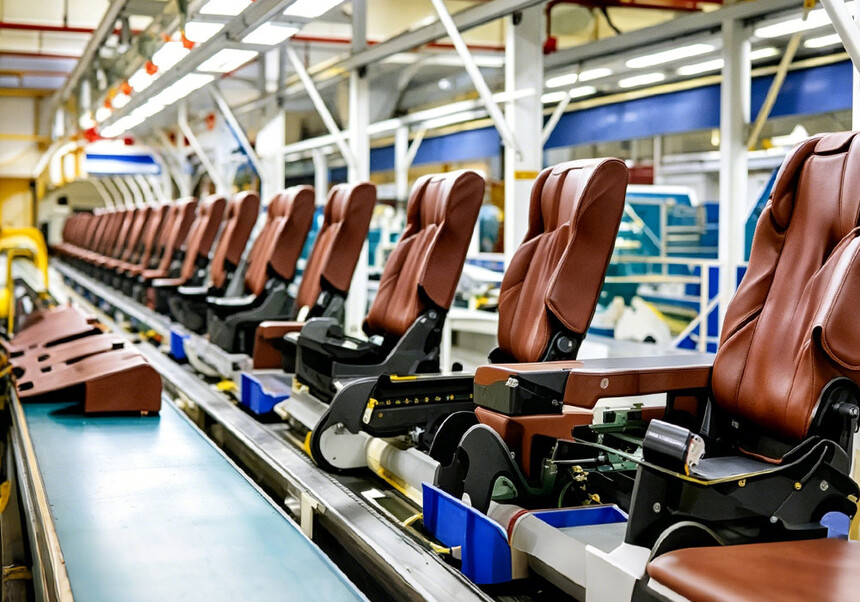
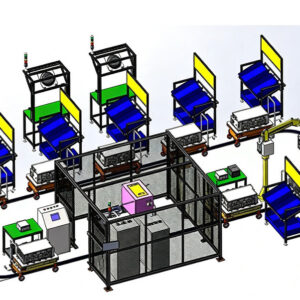
This integrated loop automated assembly line is designed for passenger vehicle seat frames, foam cushions, and electronic adjustment modules. It automatically completes processes including frame fastening, motor assembly, slide rail endurance testing, seat angle electronic control testing, and visual cosmetic inspection. Equipped with RFID pallet loop conveying and Siemens PLC centralized control, the line is compatible with flexible mixed-model production for various vehicle seat types. It can be seamlessly integrated into the vehicle interior final assembly workshop for synchronized use.
Key Advantages & Highlights
|
In-Line Electronic Endurance Testing for Slide Rails |
Simulates tens of thousands of angle adjustments synchronously during assembly to screen out jamming and motor failures. |
|
Multi-Axis Synchronous Intelligent Tightening System |
Synchronous fastening of multiple bolts on the seat frame ensures uniform torque and prevents deformation. |
|
Loop Pallet Circulation |
Automatic return of empty pallets, reducing manual material transfer labor. |
|
Vision-Based Fitment Inspection for Foam Cushions |
Identifies defects such as cushion wrinkles and assembly misalignment. |
|
One-Click Vehicle Model Program Changeover |
Built-in process database for 20 seat models, with a changeover time of ≤ 1.5 hours. |
|
Fully Enclosed Safety Guarding |
Equipped with photoelectric safety light curtains along the entire line to eliminate the risk of hand-pinching during assembly. |
Core System Specifications Table
|
Applicable Products |
Front and rear power/manual seat assemblies for ICE (Internal Combustion Engine) and NEV (New Energy Vehicle) models |
|
Standard Production Cycle Time |
220s / unit |
|
Control System |
Siemens S7-1516 PLC, 15-inch Industrial HMI |
|
Number of Synchronous Tightening Axes |
6~12 axes optional, torque accuracy ±2% |
|
Slide Rail Endurance Cycles |
5,000 angle adjustment simulations per run |
|
Traceability Carrier |
High-temperature resistant RFID metal pallets, binding full assembly and inspection data |
|
Line Footprint |
54m × 4.2m |
Core Functions and Value in Detail
1. Automated Assembly of Seat Frames and Foam Cushions
AGVs transport seat frames to the production line. Robots pick and place foam cushions, adjustment motors, and slide rail assemblies. Multi-axis synchronous tightening modules fasten the frame bolts, and servo mechanisms press-fit clips to secure the cushions. Real-time monitoring of each bolt’s torque ensures that missed tightening or torque deviations trigger automatic alarms and the isolation of defective products.
2. Endurance Adjustment Testing for Power Slide Rails
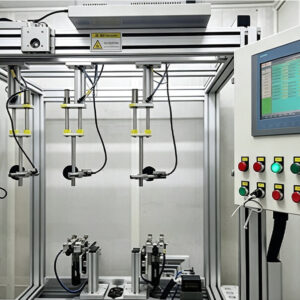
Servo systems simulate vehicle seat adjustment commands, subjecting the seat to 5,000 cycles of forward/backward and height/angle adjustments. By collecting data on motor operating current and slide rail sliding resistance, the system identifies defects such as motor wear, rail jamming, and wire harness breakage caused by stretching, preventing seat adjustment failures for end-users.
3. Vision Inspection for Foam Cushion Fitment
High-definition industrial cameras scan the surface of seat cushions to identify cosmetic defects such as wrinkles, misalignment, missing materials, and damage. Defective products are automatically diverted for rework, ensuring the overall cosmetic quality of the vehicle interior.
4. Full-Dimensional Verification of Seat Electronic Control Functions
The system simulates vehicle seat control switch signals to test the response speed of heating, ventilation, and power adjustment motors. It verifies the communication logic of the seat’s electronic control module, intercepting electronically defective parts in advance.
5. Full-Chain Digital Traceability for Seat Components
Each seat is bound to a pallet RFID. Data including frame bolt torque, motor current, slide rail endurance data, and cosmetic inspection results are all uploaded to the MES, providing a complete record of the entire seat production process and meeting OEM IATF 16949 traceability audit requirements for interior components.
Business Value:
After-sales failures related to seat adjustment jamming and cushion wrinkles are reduced by 91%. A single production line replaces 8 manual assembly and inspection workers. The loop layout significantly reduces manual material handling, adapting to the parallel batch production of seats for multiple vehicle models.
Supporting Services & Delivery Assurance
-
Pre-project: Seat frame assembly process simulation, slide rail endurance testing planning, and workshop loop production line layout planning;
-
Lead Time: 75 working days for a standard complete seat production line;
-
Implementation: In-house full-load trial production of seats → On-site joint commissioning of robots, tightening axes, and electronic control testing units → 72-hour continuous mass production acceptance test;
-
Training: Seat vehicle model program changeover, tightening torque parameter calibration, slide rail endurance program setup, and MES report exporting;
-
After-sales: 1-year warranty for the entire machine, and a 2-year warranty for robots and servo tightening units; 4-hour response time, nationwide 24-hour on-site maintenance; lifetime cost-effective supply of seat positioning fixtures and sealing consumables.
Motor Production Assembly Line
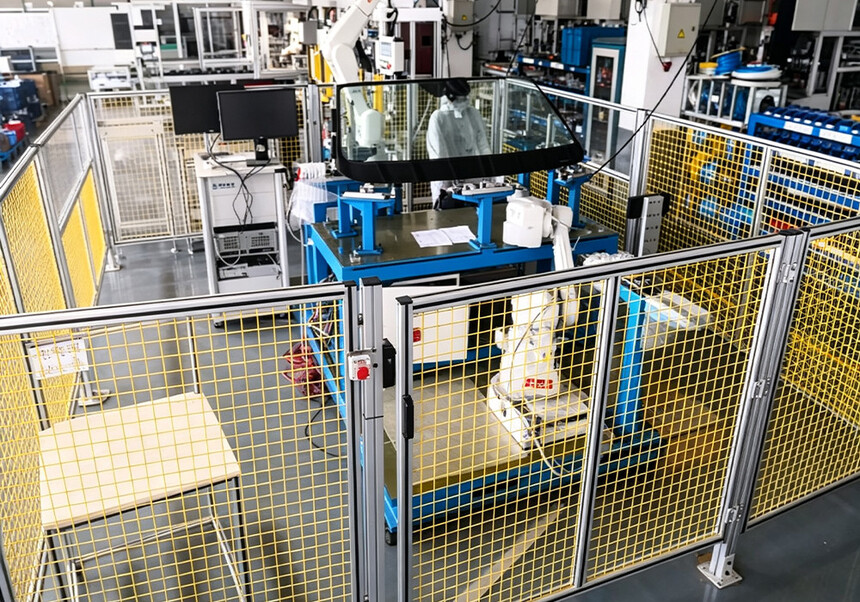
This complete automated assembly and inspection line is designed for on-board cooling fan motors and water pump motors. It covers the entire process, including stator and rotor press-fitting, dynamic balancing correction, housing sealing, power-on endurance testing, and NVH (Noise, Vibration, and Harshness) testing. Featuring a modular assembly line design, it is compatible with various 12V/24V small on-board drive motors. It can be operated as a standalone unit or integrated into thermal management and vehicle component final assembly lines.
Key Advantages & Highlights
|
Integrated In-Line Dynamic Balancing Correction |
Automatically corrects rotor dynamic balance synchronously during assembly, eliminating motor vibration and abnormal noise from the source. |
|
Flexible Compatibility for Multi-Category On-Board Motors |
One-click process program changeover between fan motors and water pump motors. |
|
NVH Soundproof Testing Enclosure |
Accurately identifies defects such as bearing wear and abnormal noise caused by rotor eccentricity. |
|
Dual-Dimensional Closed-Loop Performance Testing (Torque & Current) |
Comprehensively verifies the motor’s power output performance. |
|
Modular Detachable Units |
Dynamic balancing and testing workstations can be detached separately to serve as trial production fixtures. |
|
Compact Loop Circulation Layout |
Footprint is reduced by 30% compared to a linear production line for equivalent capacity. |
Core System Specifications Table
|
Applicable Products |
On-board cooling fan motors, battery water-cooling pump motors, HVAC blower motors |
|
Standard Production Cycle Time |
160s / unit |
|
Control System |
Siemens S7-1500 PLC, 12-inch Industrial HMI |
|
Dynamic Balancing Correction Accuracy |
≤0.5g·cm |
|
NVH Soundproof Enclosure Background Noise |
≤ 28dB(A), sound level meter accuracy ±0.5dB |
|
Operating Voltage Compatibility |
Automatic switching output for DC 12V/24V |
|
Traceability Method |
2D barcode on motor housing binding dynamic balance, torque, and noise inspection data |
|
Line Footprint |
44m × 3.6m; standalone dynamic balancing workstation 7m² |
Core Functions and Value in Detail
|
Motor Stator and Rotor Precision Press-Fitting Assembly |
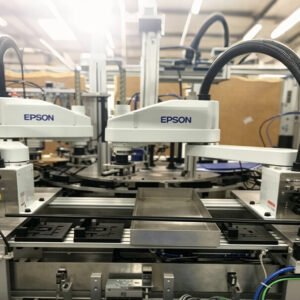
Servo presses perform closed-loop press-fitting of stator and rotor assemblies, with real-time monitoring of press-fitting force and displacement curves. Automatic alarms are triggered for rotor eccentricity or incomplete press-fitting. Robots automatically pick bearings, housings, and gaskets to complete assembly and fastening, eliminating bearing misalignment faults. |
|
In-Line Automatic Rotor Dynamic Balancing Correction |
After rotor assembly is completed, it is fed into the dynamic balancing station. The equipment automatically detects the eccentricity and performs milling to correct the unbalanced weight, controlling the dynamic balance accuracy within 0.5g·cm. This eliminates the root causes of motor vibration and abnormal noise during high-speed operation. |
|
Power-On Endurance Performance Testing under Load Conditions |
Simulates the load resistance of vehicle water pumps and fans. The motor runs in continuous cyclic start-stop operation for 30 minutes, collecting no-load and load current, as well as output torque, to identify defects such as coil short circuits, bearing wear, and insufficient power. |
|
NVH Soundproof Abnormal Noise Testing |
Workpieces are fed into a sealed acoustic enclosure. The motor operates across all high and low-speed levels to collect noise frequency spectra. The system automatically compares the data against standard noise curves to accurately capture abnormal noise from rotor eccentricity and bearing friction, preventing motor noise complaints during vehicle driving. |
|
Full-Process Quality Traceability for Motor Production |
Each motor is bound to a housing 2D barcode. Data including press-fitting force, dynamic balancing correction values, torque, and noise inspection results are stored locally for 10 years. Integrated with the MES, this meets the OEM’s quality traceability standards for on-board motor components. |
Supporting Services & Delivery Assurance
-
Pre-project: Motor dynamic balancing process sample testing, NVH soundproofing solution design, and workshop production line layout planning;
-
Lead Time: 60 working days for a standard complete motor production line, and 30 working days for a standalone dynamic balancing unit;
-
Implementation: In-house full-load trial production of motors → On-site joint commissioning of dynamic balancing, acoustic enclosures, and electronic control testing units → 72-hour continuous trial run acceptance;
-
Training: Dynamic balancing correction parameter calibration, NVH noise program debugging, and motor vehicle model program changeover;
-
After-sales: 1-year warranty for the entire machine, and a 2-year warranty for dynamic balancing sensors and acoustic sound level meters; 4-hour written response time and nationwide 24-hour on-site maintenance; lifetime cost-effective supply of bearing positioning fixtures and milling cutters.
Reviews
There are no reviews yet.