Semi-Automatic Assembly Workstation
Description
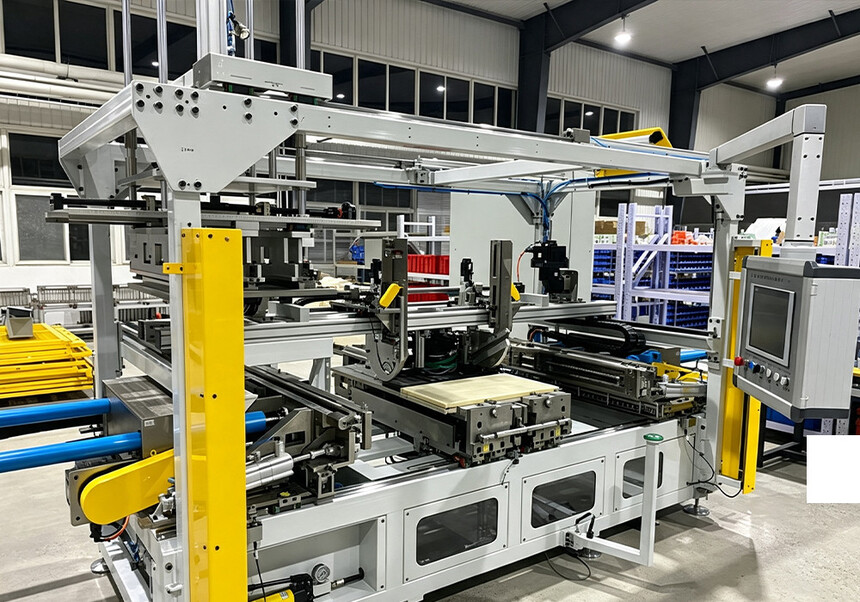
This workstation is a lightweight semi-automatic assembly station developed for small-batch trial production of multi-category components, multi-specification flexible prototyping, and medium-to-low volume mass production. It covers assembly scenarios for automotive thermal management components, electronic controllers, valves, and small interior trim parts.
It integrates servo press-fitting units, electric tightening modules, simple positioning fixtures, photoelectric safety protection, and handheld barcode scanning traceability modules. It can be operated as a standalone unit or integrated into a fully automated production line as a pre-station or material replenishment station.
Balancing automation precision with manual flexibility, it significantly reduces the upfront equipment investment required for fully automated lines. It is ideally suited for production scenarios such as new product R&D, small-batch orders, and environments with frequent changeovers across multiple product varieties.
Key Advantages & Highlights
|
Human-Machine Collaborative Flexible Production |
Automation for critical processes; manual-assisted positioning for complex/irregular parts, balancing efficiency and changeover flexibility. |
|
Lightweight & Low-Cost Investment |
Reduces investment by 60% compared to fully automated lines. Compact footprint, with no need for large-scale factory renovations. |
|
Modular & Scalable Upgrade |
Robots, vision inspection, and RFID pallet units can be added later for a seamless upgrade to a fully automated workstation. |
|
Full-Process Data Traceability |
Handheld barcode scanners bind workpieces. Press-fitting and tightening data are stored locally and integrated with the MES. |
|
Quick-Change Fixture Structure |
Quick-change positioning fixtures; product changeover time ≤ 20 mins with built-in multiple process programs. |
|
Multi-Layer Safety Protection Design |
Safety light curtains, emergency stop buttons, and pressure overload protection prevent hand-pinching and crushing accidents. |
Core System Specifications Table
|
Applicable Products |
Automotive valves, small HVAC components, electronic controllers, sunroof/door handle interior trims, and small thermal management valve bodies |
|
Standard Cycle Time per Workstation |
120~300s / unit, adjustable based on manual-assisted processes |
|
Control System |
Siemens S7-1500 compact PLC, 10-inch simplified industrial HMI |
|
Press-Fitting Force Range |
0.1~10kN, accuracy ±1% FS |
|
Tightening Torque Range |
0.05~25N·m, servo closed-loop torque control |
|
Traceability Method |
Handheld 1D/2D barcode scanner for single-piece data binding |
|
Changeover Time |
≤ 20 minutes, quick-change positioning fixtures |
|
Workstation Footprint |
6m², optional movable casters |
|
Expansion Interfaces |
PROFINET, Modbus; supports integration with vision systems, robots, and assembly line conveyors |
Core Functions and Value in Detail
|
Servo Precision Automated Assembly Processes |
Automatically completes standard processes such as gasket press-fitting, terminal crimping, and bolt tightening. The system performs closed-loop acquisition of press-fitting force and tightening torque curves. In case of pressure out-of-tolerance, missed tightening, or loose tightening, the equipment automatically locks and alarms to eliminate assembly defects from the source. Manual labor is only responsible for loading irregular workpieces and aligning complex structures, significantly reducing manual assembly errors. |
|
Flexible Prototyping for New Products in Small Batches |
Built-in process program database for over 20 products. When customers develop new products, they only need to import process parameters to quickly debug the workstation without the need for new customized equipment. A single workstation can simultaneously rotate trial production of 3 to 5 different components, perfectly matching the needs of R&D laboratories and trial production workshops. |
|
Scalability for Fully Automated Upgrades |
The workstation reserves standard communication and mechanical interfaces for robots, vision inspection, and loop conveyor lines. When customers need to increase capacity later, they can directly install 6-axis robots, vision cameras, and RFID pallet conveying modules to upgrade to a fully automated workstation on-site. Original electrical controls, press-fitting, and tightening units are fully reused to avoid the waste of duplicate equipment purchases. |
|
Lightweight Digital Traceability Management |
Operators use handheld barcode scanners to scan workpiece 2D barcodes. The equipment automatically binds and stores assembly pressure, torque, operation time, and operator ID. Data can be integrated with the factory MES to generate simple quality inspection reports, meeting the quality traceability requirements of basic components. |
|
Safety Interlock Protection and Control |
Photoelectric safety light curtains are installed on both sides of the workstation. When a human hand reaches into the working area, press-fitting and tightening actions are automatically paused. Pressure overload or program failure triggers an emergency stop lock, and the HMI simultaneously pops up fault codes to ensure operator personal safety. |
Supporting Services & Delivery Assurance
-
Pre-project Services: Free trial assembly for workpiece processes, workstation layout planning, and 3D drawing design for quick-change fixtures;
-
Lead Time: 25 working days for a standard semi-automatic workstation;
-
Implementation & Delivery: In-house sample assembly and debugging → Complete machine packaging and shipping → On-site joint commissioning of electrical controls and press-fitting/tightening units → 48-hour continuous trial production acceptance;
-
Training Services: Workstation program changeover, press-fitting/torque parameter calibration, barcode scanning traceability operations, and basic troubleshooting;
-
After-sales Support: 1-year warranty for the entire machine, and a 2-year warranty for servo press-fitting and tightening modules; 4-hour response to written requests, and nationwide on-site engineer dispatch within 24 hours; lifetime cost-effective supply of quick-change positioning fixtures and barcode scanner consumables; free provision of technical solutions for workstation upgrades and modifications.
Reviews
There are no reviews yet.