Automated Laser Processing Production Line
-
Turnkey automated line solutions for laser welding and laser cutting.
-
Covers laser processing requirements across multiple industries, ensuring stable and highly efficient operation.
Description
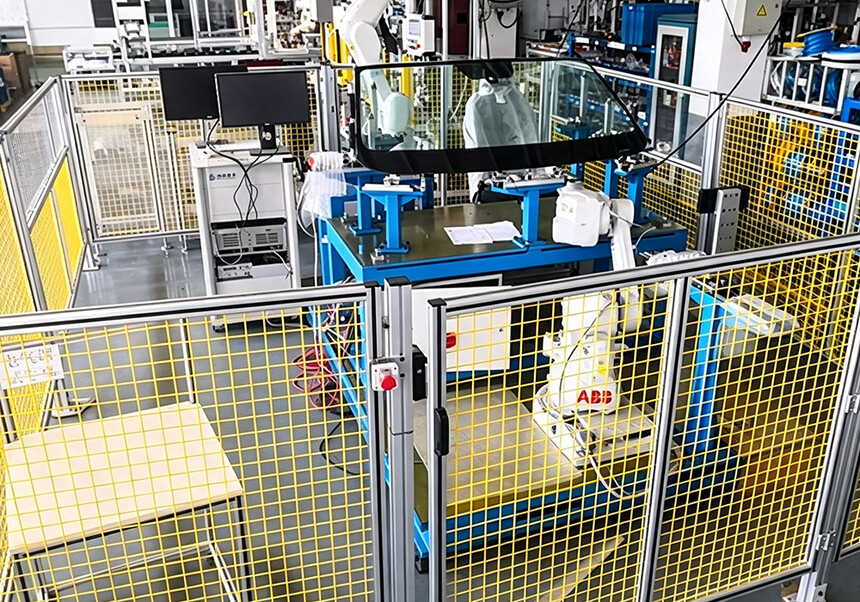
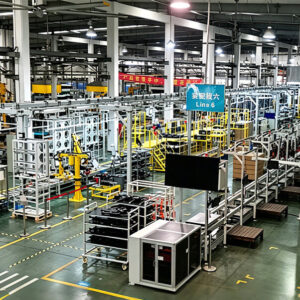
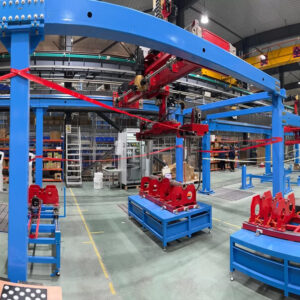
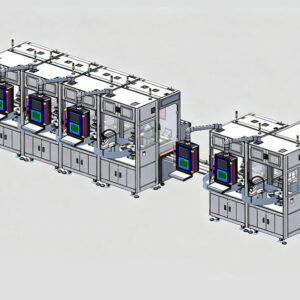
This integrated automated laser welding production line is developed for automotive thermal management pipelines, energy storage liquid-cooled pipelines, and metal heat exchange components. It integrates the full process, including robotic loading and unloading, vision positioning, fiber laser welding, weld seam vision inspection, and airtightness leak testing. Suitable for the welding production of aluminum and stainless steel heat exchange tubing, it is equipped with a laser safety enclosure, a fume purification system, and a PROFINET bus control system. It can be operated as a standalone laser workstation or as an entire assembly line interfaced with assembly processes, achieving unmanned synchronized operations for welding, inspection, and sorting.
Key Advantages & Highlights
|
Vision-Based Adaptive Welding |
Automatically corrects the laser path for slight workpiece deviations, eliminating the need for high-precision fixture positioning. |
|
In-Line Synchronous Leak Testing Post-Welding |
Immediately connects to the vacuum leak testing station after laser welding is completed, achieving welding and sealing verification in a single process. |
|
Fully Enclosed Laser Safety Protection |
Features a light-blocking safety enclosure, door-interlocked emergency stops, and multi-layer laser radiation protection, fully complying with national safety standards for laser equipment. |
|
Integrated Fume Purification System |
Centralized collection and filtration of welding fumes, meeting workshop environmental emission standards. |
|
Flexible Multi-Material Compatibility |
One-click switching of welding parameters for aluminum and stainless steel pipelines, adapting to on-board and energy storage heat exchange tubing. |
|
Full Traceability of Welding Data |
Laser power, welding speed, weld seam defects, and leak test data are bound and stored for individual parts. |
Core System Specifications Table
|
Applicable Products |
Automotive HVAC aluminum pipelines, energy storage liquid-cooled stainless steel pipelines, plate heat exchanger welding components |
|
Standard Cycle Time |
150~240s / unit, adjustable based on weld seam length |
|
Control System |
Siemens S7-1500 PLC, 15-inch dedicated industrial HMI for laser processing |
|
Laser Power Options |
1000W / 1500W / 2000W fiber lasers |
|
Vision Positioning Accuracy |
±0.08mm, automatic compensation for workpiece deviation |
|
Weld Seam Inspection Accuracy |
Identifies micro-pores and crack defects down to 0.1mm |
|
Leak Detection Accuracy |
Dry vacuum 1×10⁻⁴ mbar·L/s |
|
Safety Protection |
Enclosed laser room, safety door interlock, laser radiation sensors |
|
Line Footprint |
Standard complete line 46m × 4m; standalone laser workstation 12m² |
Core Functions and Value in Detail
|
Robotic Automated Loading/Unloading & Vision Positioning |
Six-axis robots pick up pipeline workpieces and feed them into the laser fixture. 2D vision scans the pipeline joint positions to correct the laser welding path in real-time. Slight deviations in workpiece placement do not affect welding quality, significantly lowering the precision requirements for fixture machining and reducing fixture replacement costs. |
|
Fiber Laser Precision Welding Function |
The laser outputs stable energy with optimized welding waveforms for aluminum and stainless steel pipelines, ensuring uniform weld penetration without incomplete fusion, missed welds, or through-pores. Real-time closed-loop control of welding parameters with automatic shutdown alarms for power or speed abnormalities, eliminating batch welding defects. |
|
AI Vision Defect Detection for Weld Seams |
Post-welding HD cameras scan the entire weld seam. AI algorithms identify defects such as pores, cracks, lack of fusion, and misalignment. Defect locations are automatically marked and images are archived. Defective workpieces are automatically diverted for rework, intercepting potential welding sealing hazards in advance. |
|
Post-Welding In-Line Airtightness Leak Testing |
Qualified workpieces are transferred directly to the vacuum leak testing station to detect micro-leaks at the weld seams. Welding defects and pipeline sealing defects are identified in a single process, eliminating the need for secondary transfer and inspection, thereby reducing cycle time. |
|
Digital Traceability Management of Welding Processes |
Each workpiece is bound to a barcode. Laser power, welding duration, weld defect detection, and leak test values are all uploaded to the MES. This provides a complete record of welding process parameters, allowing OEMs to trace the source of pipeline welding quality and meeting the IATF 16949 control standards for automotive components. |
Supporting Services & Delivery Assurance
-
Pre-project: Pipe/tube welding process sample testing, laser power matching simulation, and laser safety enclosure layout planning;
-
Lead Time: 70 working days for a standard laser production line, and 40 working days for a standalone laser workstation;
-
Implementation: In-house full-load trial production of pipe welding → Specialized protective packaging and shipping for laser equipment → On-site joint commissioning of robots, laser generators, vision, and leak testing units → 72-hour continuous welding verification;
-
Training: Robot teaching, laser power parameter tuning, vision defect program calibration, and fume purification equipment maintenance;
-
After-sales: 1-year warranty for the entire machine, and a 2-year warranty for fiber lasers and vision cameras; 4-hour response time and 24-hour nationwide on-site maintenance; lifetime cost-effective supply of laser lenses and filter elements; annual free precision calibration of the laser optical path.
Reviews
There are no reviews yet.